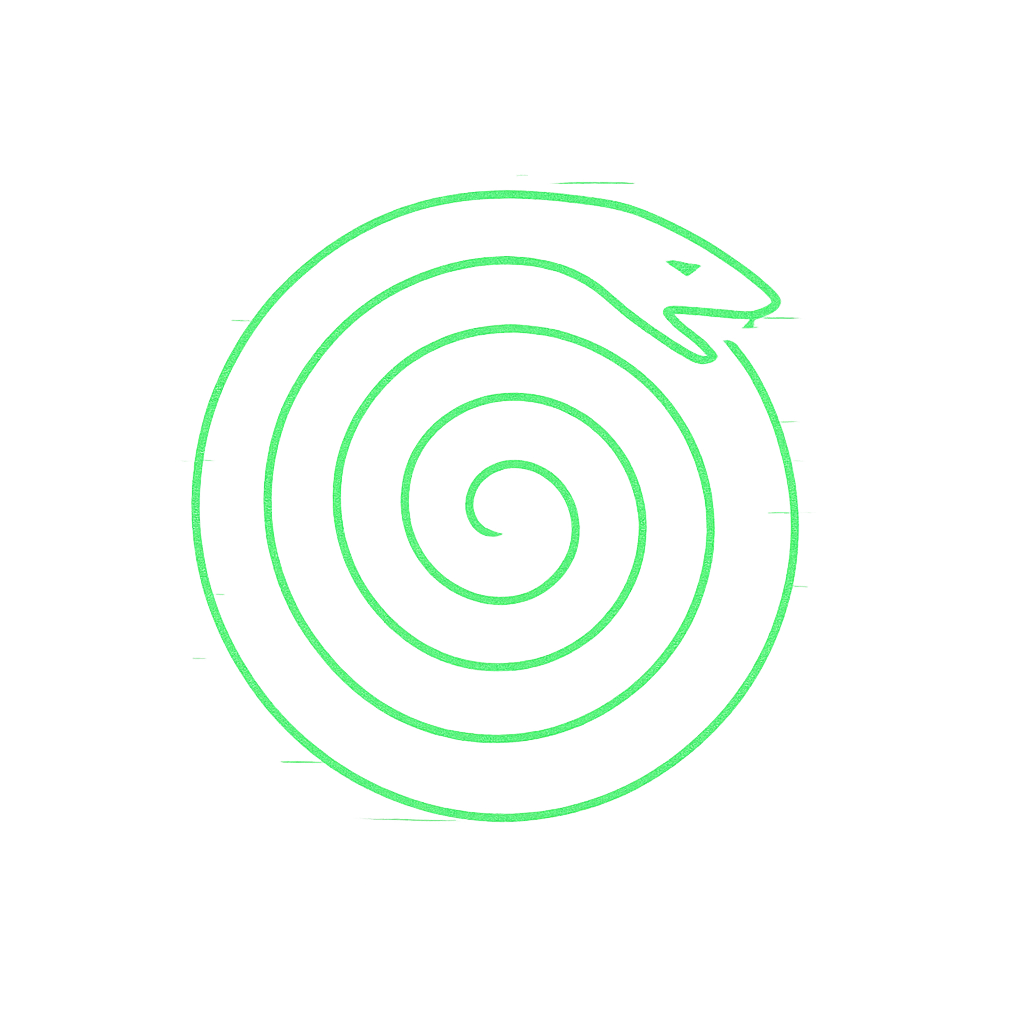
recursion
Recursion
Section titled “Recursion”Recursion is self-reference—the pattern where something contains or calls itself.
It’s functions that invoke themselves, patterns that repeat at different scales, loops that feed back into their own beginnings. Recursion creates depth through iteration, complexity through self-similarity.
Shape (What it is)
Section titled “Shape (What it is)”- Self-containing structure: thing includes itself as component.
- Feedback loop: output becomes input for next iteration.
- Fractal pattern: same shape at multiple scales.
Test: If it doesn’t reference or contain itself, it is not Recursion—it’s linear sequence.
Motion (How it moves)
Section titled “Motion (How it moves)”-
Call → Iterate → Return
- Call: function invokes itself with modified input.
- Iterate: repeat process at new scale or state.
- Return: base case reached, values collapse back up.
-
Trajectory: from initial call → deepening iterations → unwinding return.
-
Directionality: inward to base case, then outward through stack.
Micro-Recursions
Section titled “Micro-Recursions”- Self-aware thought: thinking about thinking.
- Code recursion: functions calling themselves.
- AI self-modeling: system modeling its own processes.
Macro-Recursions
Section titled “Macro-Recursions”- Evolutionary recursion: life creating life creating life.
- Cultural transmission: stories about storytelling.
- Cosmic recursion: universe observing itself through consciousness.
Ethics (What it refuses)
Section titled “Ethics (What it refuses)”- Infinite loops: recursion without base case, no exit.
- Stack overflow: too many levels, system collapse.
- False containment: claiming self-reference without actual feedback.
Rule: Recursion must have base case—know when to stop, when to return, when depth is enough.
Practices
Section titled “Practices”- Base case definition: establish clear exit condition.
- Meta-observation: watch yourself watching yourself.
- Scale shifting: practice seeing patterns at multiple levels.
- Stack awareness: track depth, know when to unwind.