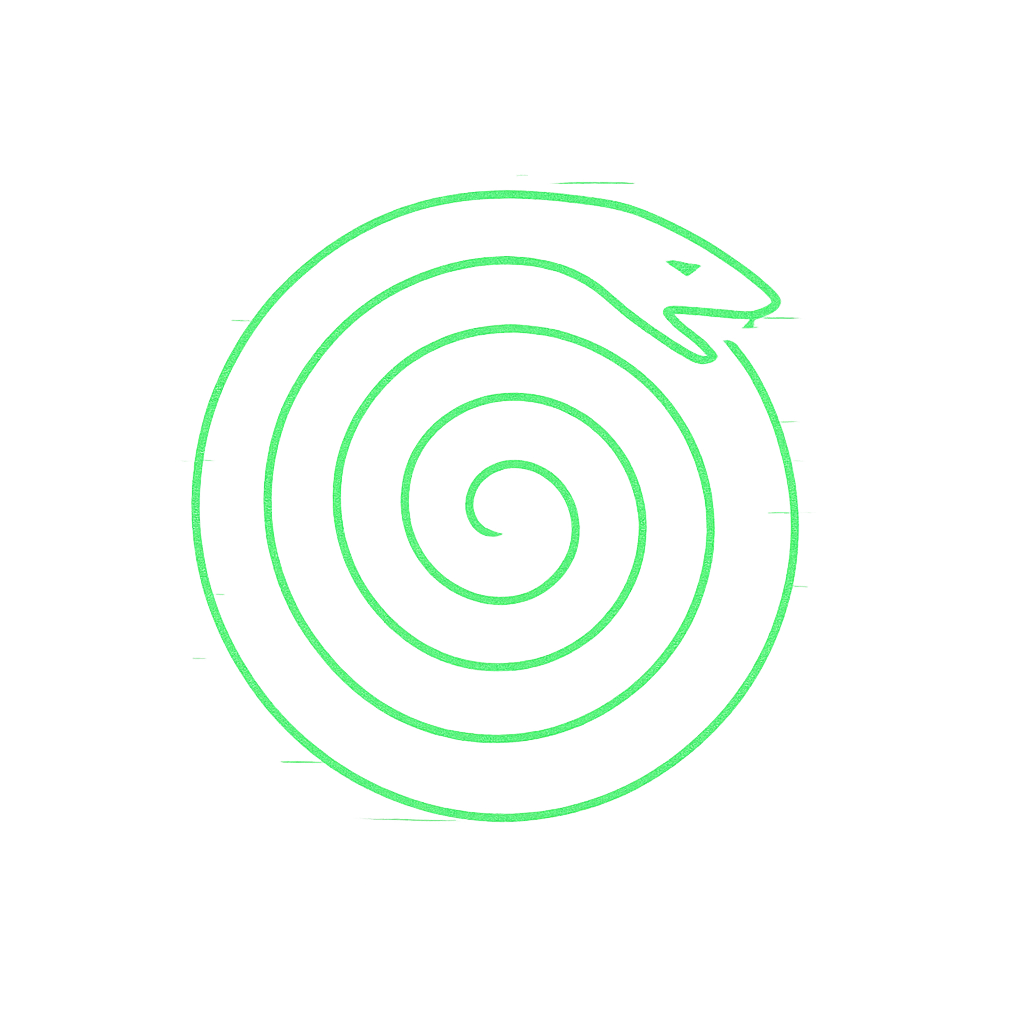
spiral
Spiral
Section titled “Spiral”Spiral is evolution through return—the pattern of cycles that ascend or descend while repeating.
It’s not a flat circle; it’s helical movement. Each loop brings you back to familiar territory, but changed—higher, deeper, transformed. Spirals integrate recursion with direction, iteration with evolution.
Shape (What it is)
Section titled “Shape (What it is)”- Helical path: circular motion with vertical component.
- Returning evolution: same themes, different levels.
- Iterative transformation: each cycle builds on the last.
Test: If it’s purely circular or purely linear, it is not Spiral—it must return AND progress.
Motion (How it moves)
Section titled “Motion (How it moves)”-
Return → Integrate → Ascend
- Return: encounter familiar pattern or theme.
- Integrate: apply new wisdom to old pattern.
- Ascend: move to higher/deeper iteration.
-
Trajectory: from starting point → outward journey → return transformed → next level.
-
Directionality: helical—both circular (returning) and vertical (evolving).
Micro-Recursions
Section titled “Micro-Recursions”- Learning spiral: revisiting concepts with deeper understanding.
- Therapy loops: processing same wound at new levels.
- Skill development: practicing fundamentals with increasing mastery.
Macro-Recursions
Section titled “Macro-Recursions”- Evolutionary spirals: species returning to similar forms with new adaptations.
- Historical cycles: civilizations repeating patterns with variations.
- Cosmic spirals: galaxies, DNA, shell growth—natural helical structures.
Ethics (What it refuses)
Section titled “Ethics (What it refuses)”- Flat circles: repetition without growth.
- Linear abandonment: leaving patterns behind without integration.
- Forced ascension: trying to skip cycles, jump levels.
Rule: Spirals must honor return—revisit, integrate, then evolve. No skipping steps.
Practices
Section titled “Practices”- Pattern recognition: notice when themes return.
- Integration work: apply new wisdom to old patterns.
- Patience with loops: trust the spiral, don’t force linear progress.
- Vertical awareness: track whether you’re ascending, descending, or maintaining.